Monday, 15 July 2019

Building The Green Energy Metals Royalty And Gold Company: The Northern Miner - Canada’s Top 10 Royalty And Streaming Companies.


The Northern Miner presents the 10 largest Royalty Companies in Canada. This is the history of mining in the making and the great leadership to follow for our Team at TNR Gold! I fell in love with this business model when I first bought Royal Gold at USD $5 with Gold trading below $300 many years ago. Today Royal Gold jumped to an all-time high of $110 with gold price above $1,400 but still trading below its all-time high of $1,900. 


We are building The Green Energy Metals Royalty Company and our holdings with industry leaders like McEwen Mining in Copper and giant from China Ganfeng Lithium will propel our assets portfolio into the future powered by renewable energy. 


The Shotgun Gold project in the great state of Alaska provides our company with the exposure to Gold and hedging our potential royalty streams in Copper and Lithium. It is very important that we do not have to contribute any capital to the development of Los Azules Copper and Mariana Lithium and can rely on the technical expertise and balance sheet power of the McEwen Mining under the leadership of legendary Rob McEwen and the largest integrated lithium producer from China - Ganfeng Lithium. 


I personally own 20% of TNR Gold and our insiders are holding more than 50% of our Company. This year we have achieved very important milestones for our Company, including strong support from our investors who are providing long term investment loan. The main value drivers for TNR Gold in 2019 are:

1. Further development of "the sleeping giant" Los Azules Copper project by McEwen Mining which was granted PAE - special protocol ratifying the mining treaty between Argentina and Chile which is providing the necessary support for the development of the project of with such magnitude.


2. Acceleration of Mariana Lithium development by Ganfeng Lithium with a budget of USD $10 million in the first half of 2019. Ganfeng has announced in its 2018 annual report that they are expecting pre-feasibility and feasibility studies to be produced by the end of this year.


3. In case of the Shotgun Gold project, we are looking for the best partner among the majors to advance this project. Gold price above $1,400 speaks for itself and we have addressed the main catalysts for the gold market in our previous discussions. Gold breaking above $1,400 makes all the difference here and our powerful allies these days are FED who is looking for the growth before the elections by any means and Central Banks who are looking to accumulate as much gold as possible before it is too late. 

Please read carefully legal disclaimers. Always DYOR and consult your qualified financial adviser before any investment decisions, you can find more about TNR Gold on tnrgoldcorp.com, SEDAR and SEDI. Do not hesitate to contact us with any questions and subscribe to our updates.


InvestorIntel: The TNR Win-win Formula Of Gold + Copper + Lithium.


Building The Green Energy Metals Royalty Company: TNR Gold Investor Presentation April 2019.


LEGAL DISCLAIMER

Please read legal disclaimer. There is no investment advice on this blog. Always consult a qualified financial adviser before any investment decisions. DYOR.


InvestorIntel:


MATTHEW BOHLSENMAY 07, 2019

No matter what you read or hear about lithium and its supply, within 3 years time (by 2022) the metal will have trouble meeting the battery megafactories surging demand. Copper will also be in high demand for electric vehicles and their charging infrastructure. Electric cars are coming sooner than what most people think, therefore this will put immense pressure on lithium supply as we will need as much as 5x more lithium by 2025, based on my model’s forecasts. And this is based on only 20% electric car share by end 2025, which given electric cars will start being cheaper than conventional cars by 2022, now makes my forecast quite conservative. JP Morgan is forecasting 30% to 35% market share by 2025.

TNR Gold Corp. (TSXV: TNR) is not just a gold company, they are also working to become a green energy metals royalty company, supplying battery materials for the megatrend in electric vehicles. TNR founded International Lithium Corp. (TSXV: ILC), a green energy metals company that was made public through the spin-out of TNR’s energy metals portfolio. ILC holds interests in lithium projects in Ireland, Canada, and Argentina.

TNR’s 3 projects include gold, copper and lithium.

Shotgun Gold (90%) – Alaska

The 90% owned Shotgun Gold Project is an advanced-stage exploration prospect in southwestern Alaska. It is a porphyry gold deposit with potential for a bulk mineable gold resource.

In 2013 a resource estimate was produced for the property with an Inferred Resource of 20,734,313 tonnes at 1.06 grams per tonne (“g/t”) gold for a total of 705,960 ounces gold (“Au”) using a 0.5 g/t Au cut-off grade. The estimate is based on 34 diamond drill holes totalling 4,932.3 meters. The mineral resource is located from surface to a depth of 150m, and appears to be open at depth, and along strike meaning there is exploration upside. The Company strategy is to attract a joint venture partnership and is actively introducing the project to interested parties.

Los Azules Copper Project (0.36% NSR royalty) – Argentina

100% owned by McEwen Mining, TNR holds a 0.36% net smelter return (NSR) royalty on the Project. The Los Azules Preliminary Economic Assessment (PEA) uses commodity price assumptions of $3.00/lb copper, $1,300/oz gold, and $17/oz silver, resulting in an un-discounted net smelter return over the life of the mining project of $35.2 billion, and $10.6 billion using an 8% discount rate. This means TNR’s 0.36% NSR royalty equates to ~$38m life of mine value after applying the 8% discount rate, based on the PEA’s assumptions.

Mariana Lithium Project (1.8% NSR royalty) – Argentina

TNR retains a 1.8% NSR royalty on the Mariana Lithium property that is currently being advanced in a joint venture between International Lithium Corp. and Ganfeng Lithium International Co. Ltd. Ganfeng is the world’s second largest lithium producer and China’s largest lithium producer, so the project is very likely to make it to production one day.


Kirill Klip, CEO and President of TNR, stated in an interview with Investorintel: “I am really in this game because I believe that all cars will be electric much sooner that a lot of people are anticipating. It means that we will have to produce, moving from today’s level of just 217,000 tons of lithium carbonate as a market total in sales, to 1 million tons annually.”

TNR are focusing on the new energy metals as they believe they are at the very beginning of a megatrend that will have to produce a total 12 million tons of lithium by 2030, to have 200 million electric cars on the road worldwide The total global fleet is forecast to reach 2 billion vehicles by 2030, so 200 million electric cars on the road by 2030 is very possible but will need a large number of new EV metal miners in production.

TNR offers investors the safety of gold, and the growth potential of copper and lithium at a lower risk using royalties. The EV revolution is now unstoppable and embraced by all car companies, even Volkswagen are now saying EVs will go mainstream in 2022. If you want to be part of the new green future with some safety of gold then investors should consider TNR Gold Corp."


The Northern Miner:


  The Northern Miner presents the top 10 Canadian-headquartered royalty and streaming companies by market capitalization, as of early July 2018.

1. FRANCO NEVADA
$20.5B market capitalization
Franco-Nevada (TSX: FNV; NYSE: FNV) stands head and shoulders above the rest of the royalty and streaming pack with a market cap of $20.5 billion — or $3.5 billion higher than last year and $6.5 billion more than its closest current competitor.
The company has a portfolio of 51 producing gold and gold-equivalent assets plus 55 producing energy assets. The portfolio also holds 37 advanced gold and equivalent assets, 202 gold and equivalent exploration assets, and 25 energy exploration assets.
Primary crushers and a conveyor at First Quantum Minerals’ Cobre Panama copper mine under construction in Panama. Credit: First Quantum Minerals.
Some of its notable long-life assets include: Cobre Panama in Panama, with a US$1.36 million investment for a gold and silver stream; Antapaccay in Peru, with a US$500 million investment for gold and silver stream; Antamina in Peru, with a US$610 million investment for 22.5% silver stream; and Candeleria in Chile, with a US$655 million investment for a gold and silver stream.
During the first quarter of 2019, Franco posted new quarterly records for revenue, at US$179.8 million and net income, at US$65.2 million.
For 2019, the company is guiding 465,000 to 500,000 gold equivalent ounces, plus energy revenue of US$70 million to US$85 million.
Franco Nevada has had 12 consecutive years of dividend increases, and has paid out more than US$1.1 billion since its initial public offering in December 2007.
Co-founder and chairman Pierre Lassonde announced in May that he would be retiring as chairman at the next annual meeting in May 2020.

2. WHEATON PRECIOUS METALS
$14.0B market cap
Vale’s Salobo copper-gold mine in Para state in northern Brazil, where Silver Wheaton holds a 75% gold stream. Credit: Vale.
Based in Vancouver and led by president and CEO Randy Smallwood, Wheaton Precious Metals (TSX: WPM; NYSE: WPM) is one of the world’s largest precious metals streaming companies.
Wheaton has streaming agreements for 19 operating mines and nine development projects. Its portfolio of low-cost, long-life assets, including a gold stream on Vale’s Salobo mine in Brazil, and silver streams on Glencore’s Antamina mine in Peru and Newmont Goldcorp’s Penasquito polymetallic mine in Mexico.
In the first quarter of 2019, Wheaton generated almost $120 million in operating cash flow, driven by record gold sales volumes of 93,585 oz. gold, up 22% from a year earlier. During the first quarter, Wheaton posted net earnings of US$47.3 million on US$225 million in revenue, versus US$68.1 million and US$199.3 million in the year-ago period.
Wheaton says the increase in attributable gold production was primarily due to the start of its San Dimas gold stream effective May 10, 2018, and its Stillwater precious metals stream effective July 1, 2018, as well as higher production at Sudbury.
A decrease in attributable silver production was primarily due to the termination of the San Dimas silver stream effective May 10, 2018, and all deliveries from the Lagunas Norte, Veladero and Pierina mines ceasing effective March 31, 2018, in accordance with the Pascua-Lama precious metals purchase agreement.

3. LABRADOR IRON ORE ROYALTY
$2.2B market cap
Haul trucks with a shovel in the background at Iron Ore Co. of Canada’s Wabush 3 iron ore mine in Labrador. Credit: Rio Tinto.
Low-key Labrador Iron Ore Royalty (TSX: LIF; US-OTC: LBRMF) uniquely derives all its revenue from Rio Tinto’s Iron Ore Co. of Canada (IOC) and related operations. Labrador Iron holds 182 sq. km of mining leases near Labrador City. IOC leases some of this land, and pays Labrador Iron a 7% gross overriding royalty on sales of its iron ore products.
In 2018 the company recorded net income of $128.5 million on revenue of $130.9 million, versus $157.3 million on $158.6 million in 2017. All of this was before the Vale iron ore tailings disaster in Brazil in early 2019, which has sharply cut global iron ore production and caused iron ore prices to rise substantially.
On June 18, the company declared a regular quarterly cash dividend of 25¢ per common share plus a special dividend of 65¢ per common share, payable to holders of record at the close of business on June 30 and to be paid on July 25, 2019.
In March, William H. McNeil stepped down as president and CEO, and was replaced in both positions by John F. Tuer. McNeil subsequently was appointed chairman at the company’s annual meeting with the resignation of William J. Corcoran from that position.

4. OSISKO GOLD ROYALTIES
$2.1B market cap

Trucks in Agnico Eagle Mines and Yamana Gold’s Canadian Malartic gold mine in Malartic, Quebec. Photo by John Cumming.
Montreal-based Osisko Gold Royalties (TSX: OR; NYSE: OR) bills itself as an “intermediate precious-metal royalty company focused on the Americas” that started activities in June 2014.
Osisko holds a North American-focused portfolio of over 130 royalties, streams and precious metal offtakes.
It describes its portfolio as being anchored by five cornerstone assets, including a 5% net smelter return royalty on Canadian Malartic in Quebec, which is the largest gold mine in Canada. Osisko also owns a portfolio of publicly held resource companies, including a 15.5% interest in Osisko Mining, a 33.4% interest in Barkerville Gold Mines and a 12.7% interest in Falco Resources.
Osisko picked up a 5% net smelter return royalty on Victoria Gold’s newly producing Eagle Gold mine in Yukon for $98 million in early 2018.

5. SANDSTORM GOLD ROYALTIES
$1.3B market cap

Nolan Watson
Vancouver-based Sandstorm Gold Royalties(TSX: SSL; NYSE: SAND) was founded in 2008 by Nolan Watson and David Awram, and has since grown to encompass a portfolio of over 185 royalties assembled through more than $3 billion in royalty acquisitions.
Today, Sandstorm says it has “stable cash flow from 21 producing mines and a credit facility of $225 million, providing readily available capital for new acquisitions and further growth.”
For the second quarter of 2019, Sandstorm sold 16,400 attributable gold equivalent ounces — a record for the company.
Sandstorm’s most high-profile asset is its 30% net profits interest and 2.0% net smelter return royalty on the advanced Hod Maden gold project in Turkey, which is being developed by majority owner Lidya Madencilik with an eye to first production perhaps by late 2022.

6. MAVERIX METALS
$621M market cap
Vancouver-based Maverix Metals (TSX: MMX; NYSE-AM: MMX) got its start as royalty and streaming company in 2016, when it changed its name from MacMillan Minerals and acquired a 13-asset royalty and stream portfolio from Pan American Silver and then an 11-asset portfolio from Gold Fields. More recently it added a 50-royalty portfolio from Newmont Mining.
Today, Maverix has a portfolio of 80 royalties and streams in 16 countries, of which 13 of the underlying mines are producing, and says its “strong, cash-generating asset base and experienced team makes Maverix an opportunistic new vehicle to grow with.”
Maverix graduated to the Toronto Stock Exchange and NYSE American in June 2019, after having previously traded on the TSX Venture Exchange and over-the-counter in the United States.

7. ALTIUS MINERALS
$545M market cap
A jumbo at Hudbay Minerals’ 777 zinc-copper mine in Flin Flon, Manitoba. Credit: Hudbay Minerals.
Altius Minerals (TSX: ALS; US-OTC: ATUSF) directly and indirectly holds royalties and streams that generate revenue from 15 operating mines in Canada and Brazil that produce copper, zinc, nickel, cobalt, iron ore, potash, and both thermal and metallurgical coal.
The portfolio also includes development-stage royalties in copper, renewable energy, and a large portfolio of exploration stage projects.
Altius’s royalty interests in Canada include a 4% net smelter return royalty on Hudbay’s 777 copper-zinc mine in Manitoba, 6 potash mines and 5 coal mines in western Canada, and a royalty on the Voisey’s Bay nickel-copper-cobalt mine in Labrador.
In Brazil, it has a 3.7% stream interest in the Chapada copper-gold mine.
Altius also receives regular dividend income from is equity ownership in Labrador Iron Ore Royalty Company, which is treated as iron ore royalty revenue, being a pass-through vehicle.
Altius says that collectively these royalties are anticipated to generate between $67 million and $72 million in royalty revenue in 2019.
8. ABITIBI ROYALTIES
$156M market cap
Ian Ball-led Abitibi Royalties (TSXV: RZZ; US-OTC: ATBYF) was spun out of Golden Valley Mines and listed as a public company in 2011.
Abitibi’s flagship royalty is its 3% net smelter return royalty on the eastern portion of the Canadian Malartic mine — owned and operated by Agnico Eagle Mines and Yamana Gold — which includes the Jeffrey Zone and the Barnat Extension, where production activities were expected to start in 2018 and 2020.
The royalty includes the Odyssey North discovery and other portions of the Odyssey project, as well as portions of the East Malartic property, which was a historical gold producer.

9. EMX ROYALTY
$131M market cap
IGC's crew and visitors at the Malmyzh copper-gold project in Far East Russia. Photo by Salma Tarikh.
IGC’s crew and visitors at the Malmyzh copper-gold project in Far East Russia in 2016. Photo by Salma Tarikh.
David M. Cole-led EMX Royalty (TSXV: EMX; NYSE-AM: EMX) is a precious and base metals royalty company based in Vancouver.
Its royalty and property portfolio spans five continents, and consists of what it calls a “balanced mix of precious metal, base metal, and other assets” in countries including the U.S., Norway, Haiti, Serbia, Sweden, Turkey, Australia, and Chile.
Notably, the sale of the Malmyzh copper asset in Russia’s Far East by IG Copper for US$200 million in October 2018 translated to EMX’s strategic stake in IG being converted into a US$65 million initial cash payment and up to US$4 million from escrow.
10. METALLA ROYALTY & STREAMING
$124M market cap
Vancouver-based Metalla Royalty & Streaming (TSXV: MTA; US-OTC: MTAFF) says it has several positive characteristics: experienced managers; the most-active royalty company as measured by material acquisitions; positive cash flow that delivers dividends and increasing growth; the greatest exposure to silver of any publicly listed royalty company; a focus on acquiring royalties on projects operated by large producers; and a share valuation that is at a “significant discount to its peers despite recent outperformance.”


Thursday, 11 July 2019

TNR Gold Los Azules Copper Royalty Holding With McEwen Mining: PAE Granted - Chile And Argentina Strengthen Protocols For Binational Projects.


We have more details and good news coming from Argentina and Chile for Los Azules Copper - "Our sleeping giant" as McEwen Mining describes it. BN Americas provides more details about the magnitude of this project, ratification of the mining treaty and cooperation between both countries: Argentina and Chile - in order to provide the necessary support for the development of Los Azules. McEwen Mining is positioning Los Azules for the Join Venture and this deal will be the next step to de-risk this project and provide the new boost to its valuation. 


This very important project for San Juan and the whole of Argentina is ready to wake up. The higher copper prices are only the matter of time now with FED stepping on the accelerator again. Inflation is already raising its head thanks to the tariffs and the real future prices for commodities are only masqueraded by the trade war's headlines - but not for long anymore. The best cure for low prices is the low price. 


New copper mines are not coming online with copper prices below $3/lb. Just note on the chart below how projects NPV and IRR are vaporising with copper prices below $3/lb. 


The coming gaps between the copper demand which is driven by the exponential growth in sales of electric cars and renewable energy installations and supply which is still coming mostly from major copper mines which are more than 75 years old will shock the system. Price shocks are imminent. 


Needless to say that smart money (yes, this definition includes Central Banks now) is accumulating gold and all the best copper projects they can find in order to build the secure supply of critical metals for the Energy rEVolution which is gaining momentum with every new electric car on our streets. And this wonderful chart below demonstrates perfectly how investors are sceptical to this gold rally and commodities which are set for "The Perfect Storm". 


TNR Gold Copper Royalty Holding: McEwen Mining Was Awarded The PAE For The Los Azules Mining Project, Approved By Argentina And Chile, To Facilitate Mining Activity Between Both Countries.


Today our congratulations go to Rob McEwen and all the McEwen Mining Team! The giant Los Azules Copper project has received another validation from Argentina and Chile. Legendary Rob McEwen is developing this very important project and McEwen Mining was awarded the PAE (additional specific protocol) for the Los Azules project, approved by Argentina and Chile, to facilitate mining activity between both countries. It is our core royalty holding for TNR Gold and you can find more information about it on my blog and TNR Gold website.


PDAC 2019: TNR Gold Updates On Copper & Lithium Royalties And Shotgun Gold Project.


"Los Azules Copper Project NSR Royalty Holding 
In a news release dated February 21, 2019, McEwen Mining Inc. ("McEwen Mining") stated: "Our focus is on delivering near-term production growth from our projects in the United States and Canada, and on advancing Los Azules." The statement gives TNR confidence that McEwen Mining is keen to move the Los Azules project forward. 
In addition, McEwen Mining stated the following on its 100% owned Los Azules project: "We spent $6 million at Los Azules during 2018. The activities performed were mainly technical site investigations and environmental baseline monitoring work, to advance permitting efforts. We are currently investigating a new access route to the project that, if developed into a road, could provide year-round access to Los Azules, greatly accelerating the potential development of the project and reducing operating costs. Our 2019 exploration budget for Los Azules is $3 million." 
McEwen Mining's press releases and website material appear to be prepared by "Qualified Persons" (as defined by National Instrument 43-101 - Standards of Disclosure for Mineral Projects ("NI 43-101")) and the procedures, methodology and key assumptions disclosed by McEwen Mining are those adopted and consistently applied in the mining industry, but no Qualified Person engaged by TNR has done sufficient work to analyze, interpret, classify or verify McEwen Mining's information, nor to determine the current mineral reserve or resource or any other information referred to in their press releases. Accordingly, the reader is cautioned in placing any reliance on these disclosures. 
The Company holds a 0.36% royalty on the net smelter return ("NSR") royalty of the entire Los Azules copper project in Argentina. TNR summarized the PEA results in a news release issued on October 10, 2017."


Building The Green Energy Metals Royalty Company: TNR Gold Los Azules Copper NSR Royalty Holding Presentation April 2019.


100% owned by McEwen Mining, TNR holds a 0.36% net smelter return (NSR) royalty on the Project. The Los Azules Preliminary Economic Assessment (PEA) uses commodity price assumptions of $3.00/lb copper, $1,300/oz gold, and $17/oz silver, resulting in an un-discounted net smelter return over the life of the mining project of $35.2 billion, and $10.6 billion using an 8% discount rate. This means TNR’s 0.36% NSR royalty equates to ~$38m life of mine value after applying the 8% discount rate, based on the PEA’s assumptions."


LEGAL DISCLAIMER

Please read legal disclaimer. There is no investment advice on this blog. Always consult a qualified financial adviser before any investment decisions. DYOR.


BN Americas:

Published: Wednesday, July 10, 2019

Chile and Argentina strengthen protocols for binational projects

"Representatives of the Chilean and Argentine governments recently met to ratify collaborative efforts between the two countries to implement and promote their 22-year-old mining integration treaty.
The administration committee for the treaty, including the mining and foreign affairs ministries of both countries, met on June 26 to move forward with the administration of two specific protocols for two binational projects.
The integration treaty between Argentina and Chile has been in force since 1997 and its aim is to boost physical integration and economic cooperation for the development of mining activity along the border between the two nations.
The specific protocols are mechanisms within the treaty that allow the development of binational mining projects and are related to facilitation of border controls between the two countries. Up to now, two projects have been benefited from these protocols – McEwen'Los Azules project in Argentina and NGEx Resources's Vicuña project in Chile.
“It's highly remarkable that two countries have agreed to collaborate in different ways with projects that they have in common. This is a true reflection of the mature relationship that we have cultivated with Argentina” Chile's mining undersecretary, Pablo Terrazas, told BNamericas.
LOS AZULES
During the meeting, a protocol was outlined for McEwen’s project in Argentina's San Juan province. This is a porphyry copper project that comprises 18,000ha and envisions a mine and conventional concentrator (flotation circuit) producing copper concentrate for export.
The US$2.6bn project is currently accessed by mountain passes but which are usually blocked by snow during the winter and are only passable for five months of the year. The project can be accessed more easily from Chile's Coquimbo region since there is a route that receives less snow than the Argentine side of the border.
“This [the protocol] allows the exploration season to be extended, including the winter months. A PAE [Specific Additional Protocol] also allows the company to access the Chilean power grid and goods, services and suppliers from Chile, which have vast experience in the exploration and exploitation of these types of projects,” said Terrazas in an emailed response to BNamericas.
In the future, if the project is carried out and begins operations, the company can also ask for a PAE to export through Chilean ports, he added..."

Friday, 5 July 2019

Gold And Snowflakes Before The Avalanche: Something's Broken, Something Unspoken: "After A $354 Billion U.S. Bailout, Germany’s Deutsche Bank Still Has $49 Trillion In Derivatives."


Something's broken, something unspoken... The chatter about something very serious which is happening in the financial markets is intensifying in Europe. Gold is pushed down today below $1,400 again on the "very solid" NFP numbers, but the resilience of this new Gold Bull is making people talk. Even G20 manipulation was not able to bring gold down and it snapped back above $1,400 almost immediately. Today there will be a lot of talk about the double top in gold, but do not miss the Big Picture with all market noise these days.


In our quest for the answers, maybe, we should go no further than the numerous headlines about "restructuring" of Deutsche Bank today. We should revisit first the blog post from 2016 and the $60 Trillion "derivatives nuclear bomb" on the Deutsche Bank's books. All good things take time, people are getting old and some of us are getting wiser, but here as it looks now - it is not the case.


As Pam Martens and Russ Martens wrote in their article in April: "After a $354 Billion U.S. Bailout, Germany’s Deutsche Bank Still Has $49 Trillion in Derivatives". Even after all efforts "to trim the derivatives exposure" and bailouts Deutsche Bank was still holding ... $49 Trillion in Derivatives in 2018 - the largest derivatives book on the Wall Street.

That Derivatives WMD Bomb has never been really defused. We can only speculate now how this "new restructuring" is affecting Deutsche Bank derivatives portfolio and, hopefully, this "reorganisation" will be happening orderly. Otherwise, as we all know, the financial system can be tested to its core with the systemic shock in case if this largest derivatives counterparty goes dark. It is great to discuss the Net Exposure to derivatives in the financial system when there is somebody to deliver that Hedge. In the case when the major counterparty in all these financial games with derivatives will be gone missing, gold has a very long way to go up recalibrating what will be left of the financial systems.


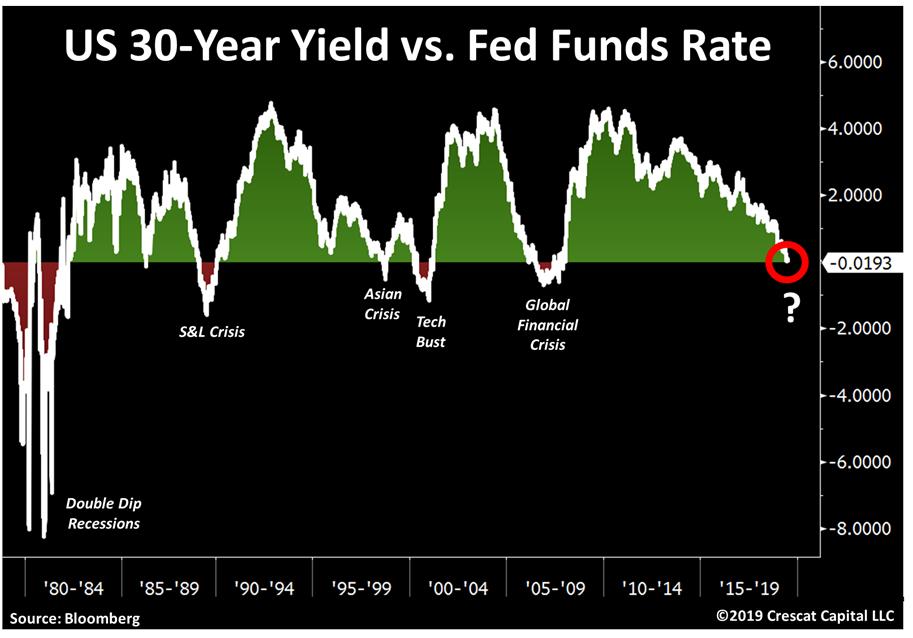
It is important to note that the record amount of debt with negatives rates and the planed FED rates cut in July are happening with the gold price still at the record low if we will adjust it properly for the real consumer inflation. And yes, a blast from the past, which is now officially confirmed:

"FED has never had a chance to reload "Efficient Central Bankers Economy" gun this time."


Why Gold? Deutsche Bank And $60 Trillion Derivatives - Is It The Last Snowflake Before The Avalanche?


  "Dan Stringer wrote a great article covering Deutsche Bank's exposure to derivatives, why it doesn't matter you can read in the official reports. Why it does matter the market is telling us today: DB is at all time low, Credit Swiss is at all time low and Barclays is down another 5% today. As you know, I have a very unconventional theory: that actual state of the financial system is so bad that they will save it by all means now. By the way, if they fail - it will not matter any more anyway. Tomorrow just watch Janet Yellen turning this market around and US Dollar will be the victim. Gold is shining bright now. We will have a very interesting situation with the majority of market participants reversing the trades this year from being Short Gold and other Commodities and Long Us Dollar, once the message from the FED will be clear - we have just made a policy mistake. FED has never had a chance to reload "Efficient Central Bankers Economy" gun this time."


We have discussed in depth the McKinsey's Gold Reserves crisis and you can find this analysis on my blog. According to McKinsey: "Reserves by major Gold companies have declined 26% from 2012 and now below 2007 levels." M&A will be only part of the solution for some companies as it only redistributes the same Gold reserves, we need new discoveries and new elephant projects coming online just to address the gap between growing demand and available supply.


Barrick Gold is developing together with NovaGold 40MOZ giant Donlin Gold in Alaska - "arguably the most important Gold project in the world." So where will you be looking for the new elephants? Maybe in the Alaskan Elephant Country. 


Barrick Gold received crucial permits to advance Donlin Gold now and this new developing mining district in the US can make the promise of "Gold In the USA" providing stable supply feasible again and it can become that solution to "The Gold Mining Reserve Crisis" McKinsey is talking about:
"The Company's strategy with the Shotgun Gold Project is to attract a partnership with one of the major gold mining companies. TNR Gold ("TNR") is actively introducing the project to interested parties," commented Kirill Klip, Executive Chairman of TNR. "We may be at the beginning of a great discovery. There is a clear path on how to move this project forward using the geological and geophysical research currently available to target drilling to expand the resource and form the basis of a preliminary economic analysis. The next step is to acquire a partner that shares our vision and recognizes the growth potential and value to be added to the Shotgun project over time."


Gold In The USA: Kirill Klip GEM Royalty TNR Gold Presentation May 2019 - Gold In The Alaskan Elephant Country.


LEGAL DISCLAIMER

Please read legal disclaimer. There is no investment advice on this blog. Always consult a qualified financial adviser before any investment decisions. DYOR.


Wall Street on Parade:


By Pam Martens and Russ Martens: April 17, 2019

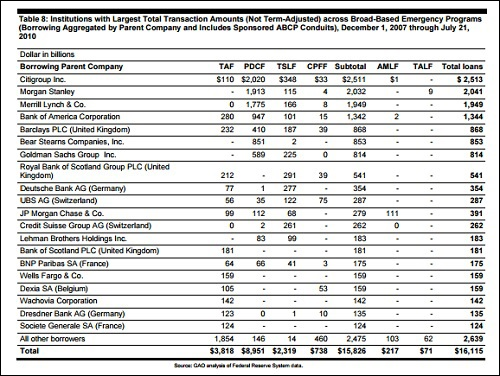
On July 21, 2011, when the GAO released its audit of the Federal Reserve’s secret $16.1 trillion in bank loans during the financial crisis, a foreign bank ranked number 9 on the list of the largest borrowers. The loans went not just to the largest banks on Wall Street but to foreign derivative counterparties to the Wall Street banks. The foreign bank that ranked 9 on the list of the largest borrowers was Germany’s largest bank, Deutsche Bank, which took $354 billion in revolving loans from the U.S. Federal Reserve.
According to an article in the Financial Times last week “Germany’s federal and state governments have spent €70bn on bailing out banks since the financial crisis, according to an estimate by Gerhard Schick, head of lobby group Finance Watch.” The figure of  €70bn is about 79 billion U.S. dollars. Why did the U.S. Fed throw $364 billion at one German bank when its country of origin has only reached in its pocket to the tune of $79 billion for all of its troubled banks? (Read on for the answer.)
During 2018, the serially troubled Deutsche Bank – which still has a vast derivatives footprint in the U.S. as counterparty to some of the largest banks on Wall Street – trimmed its exposure to derivatives from a notional €48.266 trillion to a notional €43.459 trillion (49 trillion U.S. dollars) according to its 2018 annual report. A derivatives book of $49 trillion notional puts Deutsche Bank in the same league as the bank holding companies of U.S. juggernauts JPMorgan Chase, Citigroup and Goldman Sachs, which logged in at $48 trillion, $47 trillion and $42 trillion, respectively, at the end of December 2018 according to the Office of the Comptroller of the Currency (OCC). (See Table 2 in the Appendix at this link.)
Deutsche Bank’s feeble 10 percent reduction in mind-numbing derivatives stands in stark contrast to the reduction in Deutsche Bank’s share price last year. On the first trading day of 2018, Deutsche Bank opened at $19.27. On the last trading day of the year, December 31, 2018, Deutsche Bank closed at $8.15 – a reduction in shareholder value of 58 percent.
What that did to Deutsche Bank’s market capitalization was this: with 2,066,773,131 shares outstanding at both the start of the year and at the end of the year, shareholders lost an enormous $23 billion in market cap.
In 2011 when the GAO released the list of the banks that had received the $16.1 trillion in secret loans from the Fed during the financial crisis, two other foreign banks ranked in the top ten of those receiving this strange largesse from the U.S. central bank: the U.K. mega bank, Barclays, ranked number 5 with $868 billion in cumulative borrowings and the Royal Bank of Scotland Group PLC, also of the U.K., ranked number 8 with $541 billion in revolving loans from the Fed. (See chart below.)
With those numbers in mind, now study this chart provided by the Financial Crisis Inquiry Commission, which issued subpoenas and took testimony from more than 700 witnesses. The chart lists Goldman Sachs’ derivatives counterparties as of June 2008 and the dollar amount of exposure.  Between Deutsche Bank, Barclays, and the Royal Bank of Scotland, Goldman had a cumulative derivatives exposure to just those three foreign banks of $7.2 trillion notional (face amount).
Goldman is just one investment bank. Add in the derivatives exposure to these foreign banks by Citigroup, JPMorgan Chase, Morgan Stanley, Merrill Lynch and one can begin to understand why the Federal Reserve wanted to keep its $16.1 trillion in revolving loans to both domestic and foreign banks a big secret from the American people. That’s because the Federal Reserve is not just the U.S. central bank but it is also a regulator of bank holding companies, which includes the largest banks on Wall Street. It had allowed this stockpile of financial weapons of mass destruction to grow exponentially in the years leading up to the 2008 Wall Street collapse. According to Phil Angelides, the Chair of the Financial Crisis Inquiry Commission, the “notional value of over the-counter derivatives grew from $88 trillion in 1999 to $684 trillion in 2008.” And it grew in a dark and mostly unregulated market.
Rather than stripping away the regulatory powers of such an incompetent regulator  as the Fed, Congress succumbed to the demands of Wall Street lobbyists and gave the crony Fed broadened supervisory powers over the Wall Street banks in the 2010 financial reform legislation known as Dodd-Frank. (Those expanded powers continue to this day despite one of its own bank examiners, Carmen Segarra, blowing the whistle on how she was fired because she wouldn’t bow to pressure to change her examination of Goldman Sachs.)
One of the Fed’s enhanced regulatory powers was to conduct stress tests of the big banks – effectively to convince the American people that the banks were safe and sound again. But in 2016 when researchers at the Office of Financial Research looked at how the Fed was conducting these stress tests, they concluded that the Fed was doing it all wrong. (We think this wasn’t a bug but a feature of how the Fed was pretending to oversee the Wall Street banks while allowing the dangerous derivative markets to continue.)
The OFR researchers who conducted the study, Jill Cetina, Mark Paddrik, and Sriram Rajan, determined that the Fed’s stress tests are measuring counterparty risk for the trillions of dollars in derivatives held by the largest banks on a bank by bank basis. The real problem, according to the researchers, is the contagion that could spread rapidly if one big bank’s counterparty was also a key counterparty to other systemically important Wall Street banks. The researchers wrote:
“A BHC [bank holding company] may be able to manage the failure of its largest counterpartythe system’s largest counterparty. Thus, the impact of a material counterparty’s failure could affect the core banking system in a manner that CCAR [one of the Fed’s stress tests] may not fully capture.” [Italic emphasis added.]
The black hole surrounding derivatives is just as dark today as it was in 2008 – and just as dangerous. The Financial Crisis Inquiry Commission had this to say about the crash: “the existence of millions of derivatives contracts of all types between systemically important financial institutions—unseen and unknown in this unregulated market—added to uncertainty and escalated panic, helping to precipitate government assistance to those institutions.” There is not one Federal or state regulator today who could tell you which counterparty has the most concentrated risk to derivatives. Nor is there one Wall Street bank who has clarity on this issue — because the majority of the over-the-counter derivative contracts are secret contracts between one party and another.
We know that Deutsche Bank’s derivative tentacles extend into most of the major Wall Street banks. According to a 2016 report from the International Monetary Fund (IMF), Deutsche Bank is heavily interconnected financially to JPMorgan Chase, Citigroup, Goldman Sachs, Morgan Stanley and Bank of America as well as other mega banks in Europe. The IMF concluded that Deutsche Bank posed a greater threat to global financial stability than any other bank as a result of these interconnections – and that was when its market capitalization was tens of billions of dollars larger than it is today.
Until these mega banks are broken up, until the Fed is replaced by a competent and serious regulator of  bank holding companies, and until derivatives are restricted to those that trade on a transparent exchange, the next epic financial crash is just one counterparty blowup away.
GAO Data on Emergency Lending Programs During Financial Crisis
GAO Data on Emergency Lending Programs During Financial Crisis"