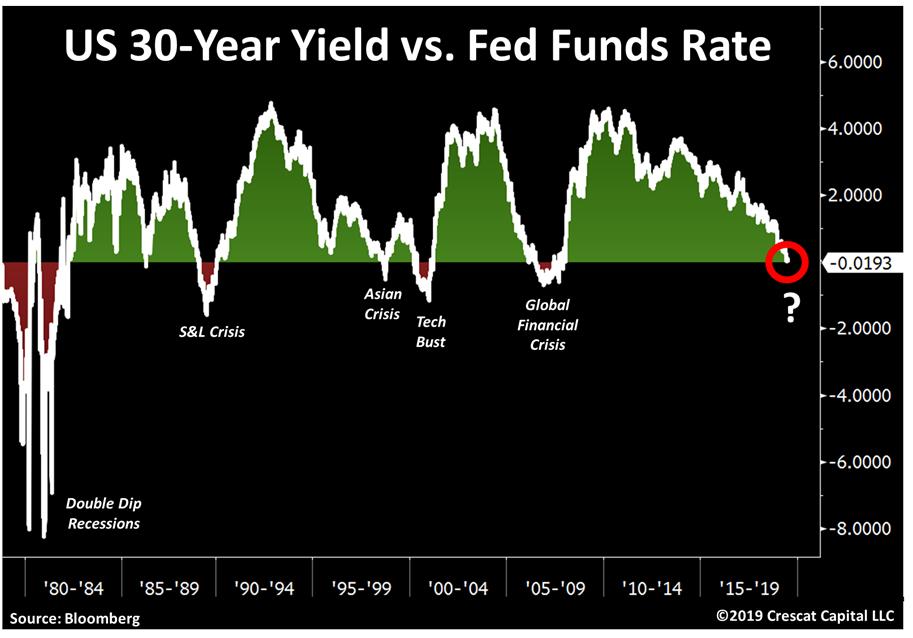
Friday, 5 July 2019

Gold And Snowflakes Before The Avalanche: Something's Broken, Something Unspoken: "After A $354 Billion U.S. Bailout, Germany’s Deutsche Bank Still Has $49 Trillion In Derivatives."


Something's broken, something unspoken... The chatter about something very serious which is happening in the financial markets is intensifying in Europe. Gold is pushed down today below $1,400 again on the "very solid" NFP numbers, but the resilience of this new Gold Bull is making people talk. Even G20 manipulation was not able to bring gold down and it snapped back above $1,400 almost immediately. Today there will be a lot of talk about the double top in gold, but do not miss the Big Picture with all market noise these days.


In our quest for the answers, maybe, we should go no further than the numerous headlines about "restructuring" of Deutsche Bank today. We should revisit first the blog post from 2016 and the $60 Trillion "derivatives nuclear bomb" on the Deutsche Bank's books. All good things take time, people are getting old and some of us are getting wiser, but here as it looks now - it is not the case.


As Pam Martens and Russ Martens wrote in their article in April: "After a $354 Billion U.S. Bailout, Germany’s Deutsche Bank Still Has $49 Trillion in Derivatives". Even after all efforts "to trim the derivatives exposure" and bailouts Deutsche Bank was still holding ... $49 Trillion in Derivatives in 2018 - the largest derivatives book on the Wall Street.

That Derivatives WMD Bomb has never been really defused. We can only speculate now how this "new restructuring" is affecting Deutsche Bank derivatives portfolio and, hopefully, this "reorganisation" will be happening orderly. Otherwise, as we all know, the financial system can be tested to its core with the systemic shock in case if this largest derivatives counterparty goes dark. It is great to discuss the Net Exposure to derivatives in the financial system when there is somebody to deliver that Hedge. In the case when the major counterparty in all these financial games with derivatives will be gone missing, gold has a very long way to go up recalibrating what will be left of the financial systems.


It is important to note that the record amount of debt with negatives rates and the planed FED rates cut in July are happening with the gold price still at the record low if we will adjust it properly for the real consumer inflation. And yes, a blast from the past, which is now officially confirmed:

"FED has never had a chance to reload "Efficient Central Bankers Economy" gun this time."


Why Gold? Deutsche Bank And $60 Trillion Derivatives - Is It The Last Snowflake Before The Avalanche?


  "Dan Stringer wrote a great article covering Deutsche Bank's exposure to derivatives, why it doesn't matter you can read in the official reports. Why it does matter the market is telling us today: DB is at all time low, Credit Swiss is at all time low and Barclays is down another 5% today. As you know, I have a very unconventional theory: that actual state of the financial system is so bad that they will save it by all means now. By the way, if they fail - it will not matter any more anyway. Tomorrow just watch Janet Yellen turning this market around and US Dollar will be the victim. Gold is shining bright now. We will have a very interesting situation with the majority of market participants reversing the trades this year from being Short Gold and other Commodities and Long Us Dollar, once the message from the FED will be clear - we have just made a policy mistake. FED has never had a chance to reload "Efficient Central Bankers Economy" gun this time."


We have discussed in depth the McKinsey's Gold Reserves crisis and you can find this analysis on my blog. According to McKinsey: "Reserves by major Gold companies have declined 26% from 2012 and now below 2007 levels." M&A will be only part of the solution for some companies as it only redistributes the same Gold reserves, we need new discoveries and new elephant projects coming online just to address the gap between growing demand and available supply.


Barrick Gold is developing together with NovaGold 40MOZ giant Donlin Gold in Alaska - "arguably the most important Gold project in the world." So where will you be looking for the new elephants? Maybe in the Alaskan Elephant Country. 


Barrick Gold received crucial permits to advance Donlin Gold now and this new developing mining district in the US can make the promise of "Gold In the USA" providing stable supply feasible again and it can become that solution to "The Gold Mining Reserve Crisis" McKinsey is talking about:
"The Company's strategy with the Shotgun Gold Project is to attract a partnership with one of the major gold mining companies. TNR Gold ("TNR") is actively introducing the project to interested parties," commented Kirill Klip, Executive Chairman of TNR. "We may be at the beginning of a great discovery. There is a clear path on how to move this project forward using the geological and geophysical research currently available to target drilling to expand the resource and form the basis of a preliminary economic analysis. The next step is to acquire a partner that shares our vision and recognizes the growth potential and value to be added to the Shotgun project over time."


Gold In The USA: Kirill Klip GEM Royalty TNR Gold Presentation May 2019 - Gold In The Alaskan Elephant Country.


LEGAL DISCLAIMER

Please read legal disclaimer. There is no investment advice on this blog. Always consult a qualified financial adviser before any investment decisions. DYOR.


Wall Street on Parade:


By Pam Martens and Russ Martens: April 17, 2019

On July 21, 2011, when the GAO released its audit of the Federal Reserve’s secret $16.1 trillion in bank loans during the financial crisis, a foreign bank ranked number 9 on the list of the largest borrowers. The loans went not just to the largest banks on Wall Street but to foreign derivative counterparties to the Wall Street banks. The foreign bank that ranked 9 on the list of the largest borrowers was Germany’s largest bank, Deutsche Bank, which took $354 billion in revolving loans from the U.S. Federal Reserve.
According to an article in the Financial Times last week “Germany’s federal and state governments have spent €70bn on bailing out banks since the financial crisis, according to an estimate by Gerhard Schick, head of lobby group Finance Watch.” The figure of  €70bn is about 79 billion U.S. dollars. Why did the U.S. Fed throw $364 billion at one German bank when its country of origin has only reached in its pocket to the tune of $79 billion for all of its troubled banks? (Read on for the answer.)
During 2018, the serially troubled Deutsche Bank – which still has a vast derivatives footprint in the U.S. as counterparty to some of the largest banks on Wall Street – trimmed its exposure to derivatives from a notional €48.266 trillion to a notional €43.459 trillion (49 trillion U.S. dollars) according to its 2018 annual report. A derivatives book of $49 trillion notional puts Deutsche Bank in the same league as the bank holding companies of U.S. juggernauts JPMorgan Chase, Citigroup and Goldman Sachs, which logged in at $48 trillion, $47 trillion and $42 trillion, respectively, at the end of December 2018 according to the Office of the Comptroller of the Currency (OCC). (See Table 2 in the Appendix at this link.)
Deutsche Bank’s feeble 10 percent reduction in mind-numbing derivatives stands in stark contrast to the reduction in Deutsche Bank’s share price last year. On the first trading day of 2018, Deutsche Bank opened at $19.27. On the last trading day of the year, December 31, 2018, Deutsche Bank closed at $8.15 – a reduction in shareholder value of 58 percent.
What that did to Deutsche Bank’s market capitalization was this: with 2,066,773,131 shares outstanding at both the start of the year and at the end of the year, shareholders lost an enormous $23 billion in market cap.
In 2011 when the GAO released the list of the banks that had received the $16.1 trillion in secret loans from the Fed during the financial crisis, two other foreign banks ranked in the top ten of those receiving this strange largesse from the U.S. central bank: the U.K. mega bank, Barclays, ranked number 5 with $868 billion in cumulative borrowings and the Royal Bank of Scotland Group PLC, also of the U.K., ranked number 8 with $541 billion in revolving loans from the Fed. (See chart below.)
With those numbers in mind, now study this chart provided by the Financial Crisis Inquiry Commission, which issued subpoenas and took testimony from more than 700 witnesses. The chart lists Goldman Sachs’ derivatives counterparties as of June 2008 and the dollar amount of exposure.  Between Deutsche Bank, Barclays, and the Royal Bank of Scotland, Goldman had a cumulative derivatives exposure to just those three foreign banks of $7.2 trillion notional (face amount).
Goldman is just one investment bank. Add in the derivatives exposure to these foreign banks by Citigroup, JPMorgan Chase, Morgan Stanley, Merrill Lynch and one can begin to understand why the Federal Reserve wanted to keep its $16.1 trillion in revolving loans to both domestic and foreign banks a big secret from the American people. That’s because the Federal Reserve is not just the U.S. central bank but it is also a regulator of bank holding companies, which includes the largest banks on Wall Street. It had allowed this stockpile of financial weapons of mass destruction to grow exponentially in the years leading up to the 2008 Wall Street collapse. According to Phil Angelides, the Chair of the Financial Crisis Inquiry Commission, the “notional value of over the-counter derivatives grew from $88 trillion in 1999 to $684 trillion in 2008.” And it grew in a dark and mostly unregulated market.
Rather than stripping away the regulatory powers of such an incompetent regulator  as the Fed, Congress succumbed to the demands of Wall Street lobbyists and gave the crony Fed broadened supervisory powers over the Wall Street banks in the 2010 financial reform legislation known as Dodd-Frank. (Those expanded powers continue to this day despite one of its own bank examiners, Carmen Segarra, blowing the whistle on how she was fired because she wouldn’t bow to pressure to change her examination of Goldman Sachs.)
One of the Fed’s enhanced regulatory powers was to conduct stress tests of the big banks – effectively to convince the American people that the banks were safe and sound again. But in 2016 when researchers at the Office of Financial Research looked at how the Fed was conducting these stress tests, they concluded that the Fed was doing it all wrong. (We think this wasn’t a bug but a feature of how the Fed was pretending to oversee the Wall Street banks while allowing the dangerous derivative markets to continue.)
The OFR researchers who conducted the study, Jill Cetina, Mark Paddrik, and Sriram Rajan, determined that the Fed’s stress tests are measuring counterparty risk for the trillions of dollars in derivatives held by the largest banks on a bank by bank basis. The real problem, according to the researchers, is the contagion that could spread rapidly if one big bank’s counterparty was also a key counterparty to other systemically important Wall Street banks. The researchers wrote:
“A BHC [bank holding company] may be able to manage the failure of its largest counterpartythe system’s largest counterparty. Thus, the impact of a material counterparty’s failure could affect the core banking system in a manner that CCAR [one of the Fed’s stress tests] may not fully capture.” [Italic emphasis added.]
The black hole surrounding derivatives is just as dark today as it was in 2008 – and just as dangerous. The Financial Crisis Inquiry Commission had this to say about the crash: “the existence of millions of derivatives contracts of all types between systemically important financial institutions—unseen and unknown in this unregulated market—added to uncertainty and escalated panic, helping to precipitate government assistance to those institutions.” There is not one Federal or state regulator today who could tell you which counterparty has the most concentrated risk to derivatives. Nor is there one Wall Street bank who has clarity on this issue — because the majority of the over-the-counter derivative contracts are secret contracts between one party and another.
We know that Deutsche Bank’s derivative tentacles extend into most of the major Wall Street banks. According to a 2016 report from the International Monetary Fund (IMF), Deutsche Bank is heavily interconnected financially to JPMorgan Chase, Citigroup, Goldman Sachs, Morgan Stanley and Bank of America as well as other mega banks in Europe. The IMF concluded that Deutsche Bank posed a greater threat to global financial stability than any other bank as a result of these interconnections – and that was when its market capitalization was tens of billions of dollars larger than it is today.
Until these mega banks are broken up, until the Fed is replaced by a competent and serious regulator of  bank holding companies, and until derivatives are restricted to those that trade on a transparent exchange, the next epic financial crash is just one counterparty blowup away.
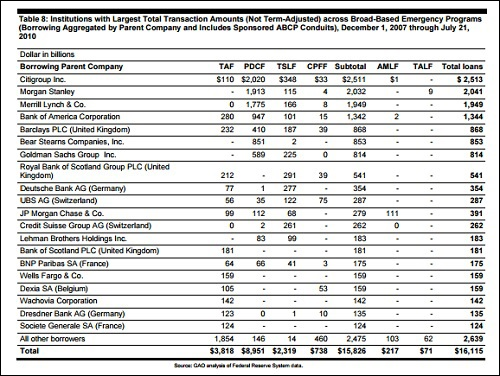
GAO Data on Emergency Lending Programs During Financial Crisis
GAO Data on Emergency Lending Programs During Financial Crisis"

Friday, 28 June 2019

TNR Gold Copper Royalty Holding: McEwen Mining Was Awarded The PAE For The Los Azules Mining Project, Approved By Argentina And Chile, To Facilitate Mining Activity Between Both Countries.


Today our congratulations go to Rob McEwen and all the McEwen Mining Team! The giant Los Azules Copper project has received another validation from Argentina and Chile. Legendary Rob McEwen is developing this very important project and McEwen Mining was awarded the PAE (additional specific protocol) for the Los Azules project, approved by Argentina and Chile, to facilitate mining activity between both countries. It is our core royalty holding for TNR Gold and you can find more information about it on my blog and TNR Gold website.


PDAC 2019: TNR Gold Updates On Copper & Lithium Royalties And Shotgun Gold Project.


"Los Azules Copper Project NSR Royalty Holding 
In a news release dated February 21, 2019, McEwen Mining Inc. ("McEwen Mining") stated: "Our focus is on delivering near-term production growth from our projects in the United States and Canada, and on advancing Los Azules." The statement gives TNR confidence that McEwen Mining is keen to move the Los Azules project forward. 
In addition, McEwen Mining stated the following on its 100% owned Los Azules project: "We spent $6 million at Los Azules during 2018. The activities performed were mainly technical site investigations and environmental baseline monitoring work, to advance permitting efforts. We are currently investigating a new access route to the project that, if developed into a road, could provide year-round access to Los Azules, greatly accelerating the potential development of the project and reducing operating costs. Our 2019 exploration budget for Los Azules is $3 million." 
McEwen Mining's press releases and website material appear to be prepared by "Qualified Persons" (as defined by National Instrument 43-101 - Standards of Disclosure for Mineral Projects ("NI 43-101")) and the procedures, methodology and key assumptions disclosed by McEwen Mining are those adopted and consistently applied in the mining industry, but no Qualified Person engaged by TNR has done sufficient work to analyze, interpret, classify or verify McEwen Mining's information, nor to determine the current mineral reserve or resource or any other information referred to in their press releases. Accordingly, the reader is cautioned in placing any reliance on these disclosures. 
The Company holds a 0.36% royalty on the net smelter return ("NSR") royalty of the entire Los Azules copper project in Argentina. TNR summarized the PEA results in a news release issued on October 10, 2017."


Building The Green Energy Metals Royalty Company: TNR Gold Los Azules Copper NSR Royalty Holding Presentation April 2019.


100% owned by McEwen Mining, TNR holds a 0.36% net smelter return (NSR) royalty on the Project. The Los Azules Preliminary Economic Assessment (PEA) uses commodity price assumptions of $3.00/lb copper, $1,300/oz gold, and $17/oz silver, resulting in an un-discounted net smelter return over the life of the mining project of $35.2 billion, and $10.6 billion using an 8% discount rate. This means TNR’s 0.36% NSR royalty equates to ~$38m life of mine value after applying the 8% discount rate, based on the PEA’s assumptions."


LEGAL DISCLAIMER

Please read legal disclaimer. There is no investment advice on this blog. Always consult a qualified financial adviser before any investment decisions. DYOR.


BN Americas:

Argentina and Chile ratify commitment to develop sustainable mining

Written by: BNamericas 
Published: Thursday, June 27, 2019

By the Argentine production ministry.

"Chile, June 26, 2019 - Argentine and Chilean authorities have ratified their cooperative ties and advanced on mechanisms that facilitate the development of mining projects, within the framework of the meeting of the administrative commission of the treaty on mining integration and complementation between the two countries.
The work teams of the administrative commission of the treaty are formed, in the case of Argentina, by the secretariat of mining policy of the production and labor ministry, headed by Carolina Sánchez, and by the directorate of economic relations for the Americas, part of the foreign affairs ministry, led by Gustavo Infante. On Chile's side was the mining undersecretariat, led by Pablo Terrazas; and the foreign affairs ministry, assistant deputy secretary, ambassador Ricardo Rojas.
The work agenda included topics of common interest such as the strengthening of the permanent working group on safety and environment, with a focus on the development of policies that encourage investment in new mining projects along with the best practices for the development of responsible mining and care for the environment.
The authorities worked on the additional specific protocol (PAE) at Vicuña and Filo del Sol and received the legal representative of the applicant company who highlighted the benefits that the PAE Vicuña implied for the project throughout the exploration stage. McEwen Mining was awarded the PAE for the Los Azules mining project, approved by Argentina and Chile, to facilitate mining activity between both countries. The representative of the company stressed the importance of the treaty in terms of logistics coordination and the competitiveness that this generates for the company.
Likewise, the guidelines of an internal procedure were established to unify approval in the border areas between both countries through the early intervention of the mixed boundary commission.

The objective of the mining treaty between Argentina and Chile is to promote physical integration and economic cooperation. In this sense, both countries are committed to work on border facilitation with the objective of promoting the development of the mining sector, enable access and exit from the areas of operations from both territories and allow the use of natural resources, inputs and infrastructure as established by the teams of technical specialists."

Sunday, 23 June 2019

Gold In The USA: The Alaskan Elephant Country - Basel III Moves Gold Closer To Officially Being Money Again.


We have finally the Summer FED's Gold Party and fireworks before the 4th of July this year! Last week Gold hit a 6-year high at $1,415 and closed on the weekly chart above $1,400. We have a breakout for gold in all currencies now, as the chart from Northstar demonstrates above and below. 


As we have discussed, our observations about the misallocations of capital and depressed valuations can remain just the subject of the brave scientific debates unless the serious money will be coming into the market: last Friday we saw the largest buying spike in daily volume since 2009.


Now we are in a great company: Central Banks are buying gold and billionaires are pushing their own golden books to the mass media and investors. They all get the memo about "Basel III moving Gold closer to officially being money again." The irony is, of cause, that Gold is Money and the real money knows it very well...


Nick Giambruno from Doug Case's International Man has written the great article about the main drivers for gold and I would like to share it today with you. 


The smart money was selling dollar into the strength and now US Dollar Party was crashed by the FED with the chart printing very decisive picture of wise ideas being implemented to stimulate all assets growth "to the moon" by throwing dollar under the bus. "Growth solves a lot of problems", but what to do when it is not here anymore? As I have mentioned before: "at least it is not a war ..." Yet. What will be next will be very important and in my presentation below you can find a lot of charts to stimulate creative thinking, including charts showing the valuations for gold and gold mining stocks. 


We are coming out of the major bear markets for both sectors and now, finally, the gold market fundamentals are supported by the smart money of the super elite club of Central Bankers and billionaires. They will deal with bitcoin later, as we have to note that derailed cryptocurrency has heard the scream "to the moon" as well and jumped above $11,000 yesterday. 


Now McKinsey's research about The Gold Reserves Crisis will stop being just the pamphlet in a Gold Bug's dusty library and can become the manifesto calling for action for some brave fund managers searching for value in our sanity-challenging times.


We have discussed in depth the McKinsey's Gold Reserves crisis and you can find this analysis on my blog. According to McKinsey: "Reserves by major Gold companies have declined 26% from 2012 and now below 2007 levels." M&A will be only part of the solution for some companies as it only redistributes the same Gold reserves, we need new discoveries and new elephant projects coming online just to address the gap between growing demand and available supply.


Barrick Gold is developing together with NovaGold 40MOZ giant Donlin Gold in Alaska - "arguably the most important Gold project in the world." So where will you be looking for the new elephants? Maybe in the Alaskan Elephant Country. 


Barrick Gold received crucial permits to advance Donlin Gold now and this new developing mining district in the US can make the promise of "Gold In the USA" providing stable supply feasible again and it can become that solution to "The Gold Mining Reserve Crisis" McKinsey is talking about:
"The Company's strategy with the Shotgun Gold Project is to attract a partnership with one of the major gold mining companies. TNR Gold ("TNR") is actively introducing the project to interested parties," commented Kirill Klip, Executive Chairman of TNR. "We may be at the beginning of a great discovery. There is a clear path on how to move this project forward using the geological and geophysical research currently available to target drilling to expand the resource and form the basis of a preliminary economic analysis. The next step is to acquire a partner that shares our vision and recognizes the growth potential and value to be added to the Shotgun project over time."


Gold In The USA: Kirill Klip GEM Royalty TNR Gold Presentation May 2019 - Gold In The Alaskan Elephant Country.


LEGAL DISCLAIMER

Please read legal disclaimer. There is no investment advice on this blog. Always consult a qualified financial adviser before any investment decisions. DYOR.


Doug Casey's International Man:

8 Reasons a Huge Gold Mania Is About to Begin


An epic gold bull market is on the menu for 2019.
I’m not talking about a garden-variety cyclical gold bull market, but rather one of the biggest gold manias in history.
This gold mania will be riding the wave of an incredibly powerful trend… the re-monetization of gold.
The last time the international monetary system experienced a paradigm shift of this magnitude was in 1971.
Then, the dollar price of gold skyrocketed over 2,300%.
It shot from $35 per ounce to a high of $850 in 1980. Gold mining stocks did even better.
Today, gold is still bouncing around its lows. Gold mining stocks are still very cheap. I expect returns to be at least as great as they were during the last paradigm shift.
So let’s get right into it, starting with the first four catalysts that will send gold prices higher…

No. 1: Basel III Moves Gold Closer to Officially Being Money Again

The Bank for International Settlements (BIS) is located in Basel, Switzerland. It’s often referred to as “the bank of central banks.” Its members consist of 60 central banks from the world’s largest economies.
It facilitates transactions – notably gold transactions – between central banks, the biggest players in the gold market.
The BIS also issues Basel Accords, or a set of recommendations for regulations that set the standards for the global banking industry.
On April 1, 2019, Basel III went into effect around the world.
Buried among what was mostly confusing jargon was something of huge significance for gold:
A 0% risk weight will apply to (i) cash owned and held at the bank or in transit; and (ii) gold bullion held at the bank or held in another bank on an allocated basis, to the extent the gold bullion assets are backed by gold bullion liabilities.
What this means in plain English is that gold’s official role in the international monetary system has been upgraded for the first time in decades.
Banks can now consider physical gold they hold, in certain circumstances, as a 0% risk asset. Previously, gold was considered riskier and most of the time could not be classified in this way. Basel III rules are making gold more attractive.
Central bankers and mainstream economists have ridiculed gold for going on 50 years now.
They’ve tried to downplay its role in favor of fiat currencies like the U.S. dollar. They’ve tried to trick people into believing it isn’t important.
The fact is gold is real money… a form of money that is far superior to rapidly depreciating paper currencies. This is why central bankers don’t want to acknowledge how important it is.
And this is precisely why Basel III is important. It signifies the start of a reversal in attitude and policy.
Basel III is giving gold more official recognition in the international financial system. It represents a step towards the re-monetization of gold… and the recognition of this powerful trend in motion.

No. 2: Central Banks Are Buying Record Amounts of Gold

Countries are treating gold as money for the first time in generations…
In 2010, something remarkable happened. Central banks changed from being net sellers of gold to net buyers of gold. Remember, central banks are by far the biggest actors in the global gold market.
This trend has only accelerated since…
The World Gold Council reports that in 2018, central banks bought a record 651 tonnes of gold. This is the highest level of net purchases since 1971 when Nixon closed the gold window. And it’s a 75% increase from 2017.

Russia Was the Biggest Buyer

Russia’s gold reserves have quadrupled in the last decade, making it the fifth-largest holder of gold in the world.
Last year, Russia notably dumped nearly $100 billion worth of U.S. Treasuries, and, according to the World Gold Council, replaced much of it with gold.
If this trend continues, and I expect that it will, Russia will soon become the third-largest gold holder in the world.
A major reason for Russia’s gold purchases is to reduce its reliance on the U.S. dollar and exposure to U.S. financial sanctions.
It is providing a template for others to do the same, using gold as money.
For example, in 2016, news broke that Turkey and Iran were engaged in a “gas for gold” plan. Iran is under U.S. sanctions. Through the plan, Turkey can pay for gas imported from Iran with gold.
Russia, Iran, Venezuela, and others are proving they don’t need the U.S. dollar. They are conducting business and settling trade with gold shipments, which aren’t under the control of the U.S. government.
This is how gold will benefit from the U.S. government using the dollar as a financial weapon.

No. 3: Oil for Gold – China’s Golden Alternative

In 2017, when tensions with North Korea were rising, Trump’s Treasury secretary threatened to kick China out of the U.S. dollar system if it didn’t crack down on North Korea.
If the threat had been carried out, it would have been the financial equivalent of dropping a nuclear bomb on Beijing.
Without access to dollars, China would struggle to import oil and engage in international trade. Its economy would come to a grinding halt.
China would rather not depend on an adversary like this. This is one of the main reasons it created what I call the “Golden Alternative.”
Last year, the Shanghai International Energy Exchange launched a crude oil futures contract denominated in Chinese yuan. For the first time in the post-World War II era, it will allow for large oil transactions outside of the U.S. dollar.
Of course, most oil producers don’t want a large reserve of yuan.
That’s why China has explicitly linked the crude futures contract with the ability to convert yuan into physical gold – without touching the Chinese government’s official reserves – through gold exchanges in Shanghai and Hong Kong. (Shanghai is already the world’s largest physical gold market.)
Bottom line, China’s Golden Alternative will allow oil producers to sell oil for gold and completely bypass any restrictions, regulations, or sanctions of the U.S. financial system.
With China’s Golden Alternative, a lot of oil money is going to flow into yuan and gold instead of dollars and Treasuries.
CNBC estimates that the amount of redirected oil money will eventually hit $600-$800 billion. Much of this will flow into the gold market, which itself is only $170 billion.
Consider this…
China is the world’s largest importer of oil.
So far this year, China has imported an average of around 9.8 million barrels of oil per day. This number is expected to grow at least 10% per year.
Right now, oil is hovering around $60 per barrel. That means China is spending around $588 million per day to import oil.
Gold is currently priced around $1,330 an ounce.
That means every day, China is importing oil worth over 442,105 ounces of gold.
If we’re conservative and assume that just half of Chinese imports will be purchased in gold soon, it translates into increased demand of more than 80 million ounces per year – or more than 70% of gold’s annual production.
This shift hasn’t been priced
The bottom line is, China’s Golden Alternative is a big step towards gold’s re-monetization.

No. 4: The Fed’s Dramatic Capitulation

In the wake of the 2008 crash, the Federal Reserve instituted several emergency measures. The chairman at the time, Bernanke, promised Congress they would be temporary.
This included money-printing programs euphemistically called “quantitative easing” (QE). Through QE, the Fed created $3.7 trillion out of thin air.
That newly created money was used to buy mainly government bonds, which sat on the Fed’s bloated balance sheet.
The Fed also brought interest rates to the lowest levels in U.S. history. The Fed artificially brought rates down to 0% and kept them there for over six years.

Capitalism’s Most Important Price

Remember, interest rates are simply the price of borrowing money (debt). They have an enormous impact on banks, the real estate market, and the auto industry, among others.
In 2016, the Fed began its attempt to “normalize” its monetary policy by raising interest rates and reducing the size of its balance sheet to more historically normal levels. By doing so, the Fed was reversing the emergency measures put in place after the 2008 crisis.
Interest rates have risen from 0% to around 2.5%, and the Fed has drained over $500 billion from its balance sheet, or about 11% from its peak.
But then, the stock market tanked…
The S&P 500 peaked at 2,930 in late September 2018. By late December, it had crashed over 19% and appeared to be headed sharply lower.
It was the worst December in stock market history, except for December 1931, which was during the Great Depression.
That spooked the Fed into its most abrupt change in monetary policy in recent history.
Instead of normalizing monetary policy and removing the so-called “temporary” and “emergency” measures in place since 2008 – as it had long planned to do – the Fed capitulated.
Earlier this year, the Fed announced it would not raise interest rates in 2019.
The Fed also announced it would phase out its balance sheet reduction program in the fall.
Previously, the Fed was slowly winding down its balance sheet by about $30 billion a month. At such a snail’s pace, it would have taken the Fed over 10 years to drain its balance sheet back to its pre-crisis normal level.

Hooked on Easy Money

This whole charade is indicative of how utterly dependent the U.S. economy has become on artificially low interest rates and easy money.
If the Fed couldn’t normalize interest rates when the debt was $22 trillion, how is it ever going to raise rates when the debt is $30 trillion or higher?
The Fed couldn’t shrink a $4.5 trillion balance sheet. How is it going to shrink, say, a $10 trillion balance sheet or higher?
The answer is it can’t and won’t. It’s impossible for the U.S. government to normalize interest rates with an abnormal amount of debt. The Fed is trapped.
After nearly six years of 0% interest rates, the U.S. economy is hooked on the heroin of easy money. It can’t even tolerate a modest reduction in the Fed’s balance sheet and 2.5% interest rates, still far below historical averages.
In other words, this monetary tightening cycle is over. The next move is a return to QE and 0%, and perhaps negative, interest rates. These moves would, of course, weaken the dollar and be good for gold.
By flipping from tightening to signaling future easing, the Fed has turned a major headwind for the gold market into a tailwind.

No. 5: Takeover Frenzy in the Gold Mining Industry

2019 is on track to be a record-breaking year for gold mergers and acquisitions (M&A).
The world’s largest mining companies are pouring billions of dollars into mergers and acquisitions.
Three blockbuster deals contributed to this result:
  • Newmont Mining completed a $10 billion takeover of Goldcorp on April 18.
  • Barrick Gold acquired Randgold Resources in a $6 billion transaction that closed on January 1.
  • Barrick Gold has also announced a joint venture with Newmont after a hostile bid from Barrick failed. (Barrick and Newmont are the top two gold-producing companies in the world.) The joint venture in Nevada will create the largest gold-producing complex in the world.
What these mega deals prove is that the biggest companies in gold mining think gold and gold stocks are cheap.
They show a preference to grow by buying out other companies rather than discovering and developing new resources.
If this trend continues, 2019 will go down as a record-breaking year for gold M&As.
It’s another major tailwind for gold.

No. 6: President Trump Is Pro-Gold

President Trump is a big fan of gold.
For one, he’s made a killing as a gold investor. He’s called investing in gold “easier than the construction business.”
But Trump’s affinity for gold goes much deeper. He once said:
The legacy of gold as a precious commodity has transcended to become a viable currency and an accepted universal monetary standard. Central Banks around the world are holding gold as a reserve asset.
And Trump is a fan of the gold standard… in other words, the re-monetization of gold.
While running for president, he said:
Bringing back the gold standard would be very hard to do, but boy, would it be wonderful. We’d have a standard on which to base our money.
And he’s acting on his pro-gold instincts in a big way. Let me explain…
Trump has been able to wield more influence over the Federal Reserve than any other president since the Fed was created in 1913.
He’s had the chance to fill five out of the seven seats on the Board of Governors of the Federal Reserve.
In other words, Trump gets to stack over 70% of the whole Fed board with people of his choosing.
And so far, he’s nominated several pro-gold candidates, including Herman Cain and Stephen Moore. They’re both on record as supporting a gold standard.
For example, in 2012, when Cain was running for president, he wrote an editorial for The Wall Street Journal titled “We Need a Dollar as Good as Gold.” He wrote:
Gold is kryptonite to big-spending politicians. It is to the moochers and looters in government what sunlight and garlic are to vampires.
Cain and Moore have since withdrawn their nominations, but one replacement is widely suspected to be Judy Shelton, who is also an advocate of the gold standard.
Regardless, the fact that Trump nominated them in the first place shows he is willing to act on his pro-gold instincts.
Here’s the bottom line…
Having a U.S. president who favors gold and is looking to stack the Fed with pro-gold people is unprecedented in recent history. It’s a positive development for gold – and the trend of gold’s re-monetization.
But gold is going to get a boost, no matter which party is in power…

No. 7: Socialism Is on the Rise

Socialism is on the rise in the U.S. And it’s about to be entrenched in U.S. politics.
A recent poll from the Victims of Communism Memorial Foundation, a D.C.-based nonprofit, showed that one in two millennials now favors socialism and communism over capitalism.
It’s why Bernie Sanders, Elizabeth Warren, Kamala Harris, Alexandria Ocasio-Cortez (AOC), and other socialists are skyrocketing in popularity.
This is no small problem.
Millennials are now the largest demographic group in America. And sometime this year, they are expected to surpass baby boomers as the nation’s largest living adult generation.
In other words, demographics alone guarantee more socialism ahead. And as we’ve seen again and again, when asked, “How are you going to pay for this?” socialists have the same answer: “Tax the rich!”
Simple arithmetic shows that even if the rich were taxed to the limit, it wouldn’t put a dent in the bills for the socialists’ government programs. But to this, the socialists respond: “We’ll just print money!”
In comes Modern Monetary Theory (MMT). It’s the latest buzzword coming out of Washington, D.C.
Contrary to its name, MMT is neither new nor “modern.” And adding the word “theory” to something doesn’t make it scientific or credible.
MMT is the same economic quackery that’s brought misery to Argentina, Venezuela, Zimbabwe, and countless other places. Now, left-leaning U.S. economists, politicians, and policy wonks are taking it seriously, too. They see it as a sort of “QE for the people.”
For example, AOC and Stephanie Kelton, Bernie Sanders’ former chief economic adviser, are leading advocates of MMT.
In short, America’s embrace of socialism will lead to more money-printing and currency debasement, just as it has everywhere else it’s been tried.
But this time, it won’t be the Argentine peso or the Venezuelan bolívar that is debased. It will be the U.S. dollar… the world’s premier reserve currency.
Gold is the primary competitor for the U.S. dollar’s top role. And as the American socialists inflate the value of the dollar away, it will make gold all that more attractive.
That’s why this trend will be a big positive for the re-monetization of gold.

No. 8: Gold-Backed Cryptos – A Monetary Revolution

The last catalyst for gold is cryptocurrencies backed by gold.
There are dozens of gold-backed cryptos sprouting up.
Peter Grosskopf, the CEO of Sprott, recently called gold-backed cryptocurrencies “the most important thing to happen to the gold market in the last several decades.”
Soon after, Sprott launched a gold-backed crypto it developed with its partners.
When Sprott – a leader in the natural resources industry – makes a big move into the gold-backed crypto space, it’s a definitive sign of where things are headed.
Gold-backed cryptos combine the best attributes of gold and cryptos. I can’t think of two other asset classes that have as many synergies. In other words, the whole is worth much more than the sum of the parts.
With cryptos redeemable for gold, we can now instantly send anyone anywhere in the world small or large amounts of gold – reliably and without interference. It’s nothing short of a monetary revolution.
Gold-backed cryptos are going to make using gold as money even more convenient for the average person and business. Anyone with a cell phone now can use gold in a way that was not possible before.
This is another big reason why I think gold is coming back as money.

Putting It All Together…

When you take a step back and look at the big picture, the implications for gold are clear:
  • Basel III moves gold toward officially being money again.
  • Central banks are buying record amounts of gold.
  • Excessive U.S. sanctions have pushed countries to use gold.
  • China’s “Golden Alternative” allows for large-scale, oil-for-gold trades.
  • The Fed’s dramatic reversal and the return of easy money bode well for gold’s strength against the dollar.
  • The takeover frenzy in the gold mining industry is bullish for the price of gold.
  • President Trump favors returning to the gold standard and is stacking the Fed with pro-gold people.
  • The Democrats’ embrace of socialism guarantees more currency debasement.
  • Gold-backed cryptos make owning and using gold easier than ever.
Any one of these catalysts alone would be great news for gold.
But the fact they are all converging at the same time means an epic gold bull market is on the menu for 2019. And the time to get positioned is now…"